If your flights, accommodation, and passport are ready, it’s time to ask: “Am I forgetting anything?”
Before flying to South Korea, make sure the essentials you’ll need after arrival are sorted out, including entry requirements, mobile data, and payment and transportation options. It also helps to have your travel apps and accommodation details ready in advance, so your first day can go more smoothly.
Quick South Korea Travel Checklist
Before You Go | Check |
Check your passport and visa/K-ETA requirements | □ |
Check whether you need to submit an e-Arrival Card | □ |
Decide how you will use mobile data in Korea | □ |
Download essential travel apps such as NAVER Map | □ |
Prepare your cards and a backup payment method | □ |
Check how to pay for public transportation | □ |
Decide how to get from the airport to your accommodation | □ |
Save your accommodation address and booking details offline | □ |
Check your power adapter and portable charger | □ |
Check the weather and pack comfortable walking shoes | □ |
One more box to check before Korea?
If mobile data is still on your checklist, you can get it ready with a HalfSIM Korea eSIM before departure. That way, you’ll be ready to use maps, translation, taxi apps, and booking information once you arrive.
[ Get Your HalfSIM Korea eSIM Ready → ]
1. Check Your Passport and Entry Requirements
First, make sure your passport is valid and check whether you need a visa or K-ETA based on your nationality.
The temporary K-ETA exemption for eligible countries and regions has been extended through December 31, 2026. The exemption currently includes travelers from countries such as the United States, Canada, Japan, Australia, and the United Kingdom. Eligibility depends on nationality, so check the official K-ETA website before departure.
Check Whether You Need an e-Arrival Card
Travelers who are required to submit an e-Arrival Card can complete it online for free within three days before arriving in South Korea. Not every traveler needs to submit one, so use the official e-Arrival Card Navigator to check whether it applies to you.
The official e-Arrival Card is free of charge. The Korean government also warns travelers about fake websites that request payment information, so make sure you are using the official go.kr website.
Tip: Entry requirements can change. Even if you checked them when booking your flight, review the official websites again shortly before departure.
2. Decide How You’ll Get Mobile Data in Korea
You may need mobile data as soon as you arrive in Korea—for navigation, translation, calling a taxi, or checking your bookings. Decide how you’ll get online before departure so you can connect as soon as you arrive at the airport.
The main options are international roaming, a physical SIM, an eSIM, and Pocket WiFi.
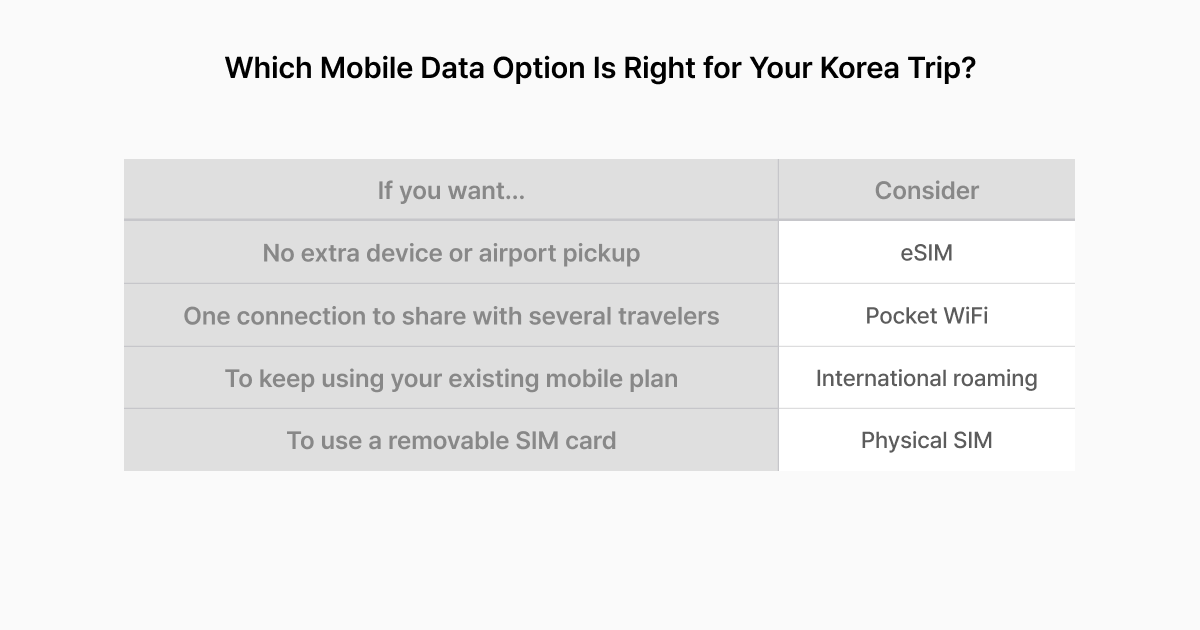
If you want a deeper comparison before choosing, read Korea eSIM vs Pocket WiFi: Best Choice for 2026 to compare eSIM, Pocket WiFi, physical SIM cards, and roaming.
If You Choose an eSIM, Get Ready with HalfSIM Before You Fly
If your phone supports eSIM, you can prepare your mobile data before departure without having to pick up a physical SIM after arriving in Korea. HalfSIM Korea eSIM offers Saver and Unlimited-data options, so you can choose a plan based on your trip length and expected data use.
Before purchasing, check that your phone supports eSIM and review the installation process in advance. Already decided on an eSIM but still comparing plans? See Best eSIM for Korea 2026: HalfSIM, Airalo, Holafly for a closer look at plan types and buying factors. If you’re using an iPhone, see iPhone eSIM for Korea: How to Install It in 2026 for step-by-step setup instructions.
Choose between 2 HalfSIM plan types for your trip
Pick the Saver or Unlimited-data option that fits your trip and expected data use.
[ Compare HalfSIM Korea eSIM Plans → ]
3. Download the Korea Travel Apps You’ll Actually Use
In South Korea, navigation, translation, train booking, and taxi calls are often handled through mobile apps.
You do not need to install every travel app. Choose the ones that fit your travel style, download them in advance, and complete any required login before departure.
NAVER Map — Navigation
NAVER Map is useful for checking walking, driving, and public transportation routes in Korea. Before your trip, search for your accommodation and a few places you plan to visit, then save them as bookmarks. Having your accommodation saved in the app can also make your first trip from the airport easier.
Papago — Translation
If you are not familiar with Korean, Papago can be useful for text, image, and voice translation. You can use the camera to translate a menu or sign, type a short sentence to show someone, or use voice translation during simple conversations.
KorailTalk — Train Schedules and Tickets
If your itinerary includes cities such as Busan, Gyeongju, or Jeonju, check your intercity train options before departure. KorailTalk can be useful for checking schedules and tickets for major trains, including KTX.
k.ride — Taxi App for International Travelers
If you expect to use taxis, you can also prepare k.ride before your trip. Having a taxi app ready means you won’t have to search for one for the first time when you actually need a ride.
Tip: Do more than just download the apps. Search for your accommodation or a few attractions once before departure.
4. Prepare Cards, Cash, and a Transit Payment Method
Card payments are common in South Korea, and foreign-issued Visa or Mastercard cards can be used at many hotels, restaurants, cafés, convenience stores, and shops.
However, foreign cards may occasionally be declined, so it’s a good idea to have a backup payment method.
Public Transportation Works a Little Differently
If you plan to use public transportation frequently, it’s a good idea to prepare a transit card such as T-money. Standard physical T-money cards can be purchased and topped up at convenience stores and subway stations.
Some top-up machines are cash-only, so carrying a small amount of Korean won is recommended. Official Tmoney guidance also recommends keeping cash on hand rather than relying on a foreign-issued card to top up a standard physical T-money card.
Tip: For a first trip to Korea, a foreign card + transportation card + small amount of cash is a practical combination.
5. Plan Your Route from Incheon Airport Before Landing
After a long flight, figuring out how to reach your accommodation from scratch can be more tiring than expected. Before departure, check which terminal you’ll arrive at, where your accommodation is located, and decide on at least one transportation option.
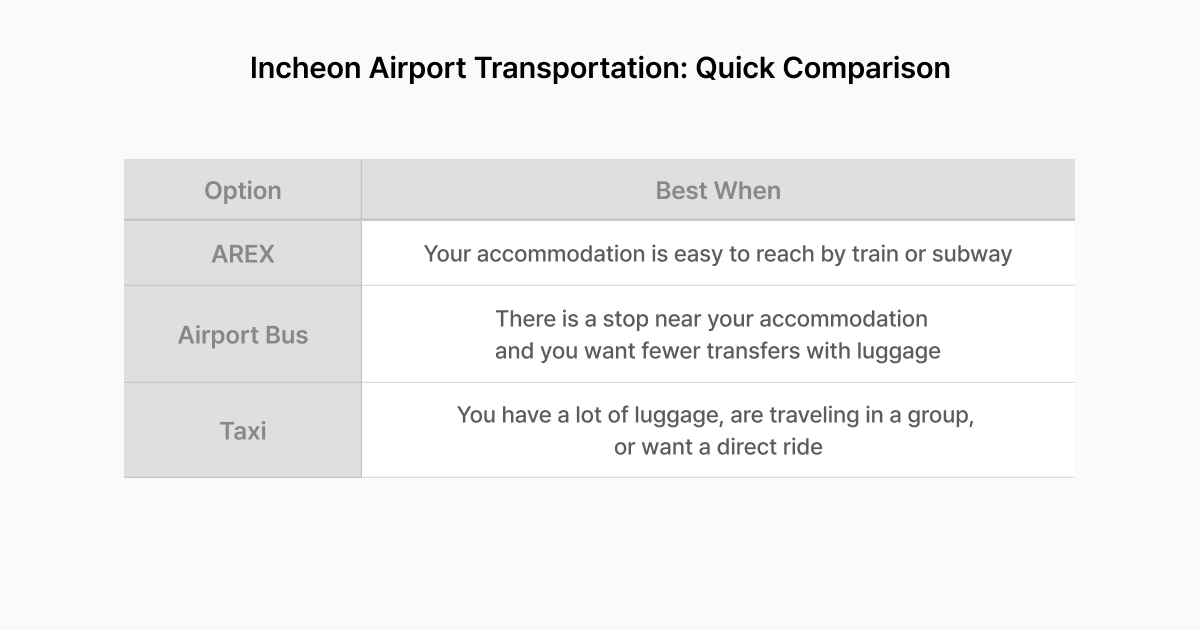
The main choices are the Airport Railroad (AREX), airport buses, and taxis.
Airport Railroad (AREX)
If your accommodation is easy to reach by train or subway, AREX can be a convenient option. Incheon Airport provides official information on station locations and access for both terminals.
Airport Bus
If there is an airport bus stop near your accommodation, taking a bus may help you avoid multiple transfers with luggage. Check the current route and boarding location before your trip. If you arrive late at night, also review the airport’s current late-night bus information.
Taxi
A taxi can be useful if you have a lot of luggage, are traveling with several people, or want to go directly to your accommodation. Incheon Airport recommends using designated taxi stands to avoid unauthorized solicitation or overcharging. There is no single best option for everyone. Choose based on your accommodation, arrival time, luggage, and group size.
Save Your Accommodation Address in Advance
Save your accommodation name, address, phone number, and booking confirmation somewhere you can access even without internet.
If possible, keep both the English and Korean versions of the address. Search for your accommodation in NAVER Map before departure and save it so you do not have to start from scratch after landing.
6. Pack for the Weather and the Way You’ll Travel
South Korea has four distinct seasons, and the weather can vary significantly depending on the time of year and destination.
Instead of relying on a generic packing list, check the actual forecast shortly before departure and pack for your specific itinerary.
Check the Weather for Your Travel Dates
Check the forecast for your travel dates and destinations shortly before departure.
Even within the same season, temperature and rainfall can vary by region and timing. In summer, indoor spaces may also feel cool because of air conditioning, so a light layer can be useful.
Bring Comfortable Walking Shoes
South Korea has convenient public transportation, but sightseeing often involves more walking than expected.
If you plan to explore several neighborhoods in one day, comfortable walking shoes can make a noticeable difference.
Pack Personal Essentials
Bring any medication you regularly take and personal items that may be difficult to replace during your trip.
If an item may be subject to import restrictions, check the relevant official rules before departure rather than relying only on travel reviews.
7. Check Your Power Adapter and Portable Charger
South Korea uses 220V, 60Hz electricity, and standard outlets have two round holes. Check whether your devices support 220V, and bring a travel adapter if your plug type is different.
Most modern phone and laptop chargers support multiple voltages, but check the input information printed on your charger rather than assuming.
Bring a Portable Charger for Long Days Out
Navigation, translation, photos, taxi apps, and mobile data can drain your phone faster than usual. If you expect to spend most of the day outside, a portable charger can be useful.
Power banks should not be packed in checked baggage. Airline rules on capacity, quantity, and onboard use can vary, so check your airline’s current policy before departure.
8. Save Important Travel Information Offline
Most travel information is stored on your phone, but it is still worth preparing for temporary connection problems, app errors, or a delay in getting online after arrival.
Save your essential details as screenshots or offline files:
- Flight information
- Accommodation name, address, and phone number
- Accommodation booking confirmation
- Train, performance, or attraction tickets
- Travel insurance information
- A copy of your passport
- Emergency contact information
In particular, keep your accommodation address and airport-route information somewhere easy to find.
Even if you arrange mobile data before departure, a simple offline backup can make your first hour in Korea much easier.
South Korea Travel Checklist by Timeline
Here is a quick summary of when to prepare each part of your South Korea travel checklist.
When | What to Prepare |
A few weeks before departure | Check passport, visa, and K-ETA requirements; decide on mobile data; download travel apps; prepare payment methods; complete necessary train or attraction bookings |
Within 3 days before arriving in Korea | Submit an e-Arrival Card if required; review current entry requirements; check the weather; confirm your airport-to-accommodation route |
The day before departure | Save booking details and your accommodation address offline; check cards and cash; pack your adapter and portable charger; review your mobile-data setup |
Your first hour in Korea | Connect to mobile data; open NAVER Map; prepare your transit payment method; follow the airport route you planned in advance |
South Korea Travel Checklist FAQ
Q. What map app should I use in South Korea?
It is safer to have a Korea-focused navigation app such as NAVER Map ready before departure rather than depending on only one map service.
Search for your accommodation and airport route in advance so you already know which app works best for your itinerary.
Q. Can I buy a T-money card after arriving at Incheon Airport?
Yes. Official T-money guidance says travelers can purchase a transit card after arriving at the airport, including at convenience stores or ticket machines.
Some top-up machines are cash-only, so keeping a small amount of Korean won is useful.
Q. Do tourists need a Korean phone number in South Korea?
Not always. Mobile data is enough for many common travel activities, including navigation, translation, web browsing, and internet-based messaging.
However, if you specifically need local calls, SMS, reservations, or a service that requires a Korean number, check whether your SIM or eSIM includes a phone number before purchasing.
Q. Can I install a Korea eSIM before my flight?
Yes, but installation and activation are not always the same thing. With HalfSIM, you can install your eSIM before departure, and your plan does not start just because you install it. The validity period begins when you first use mobile data in Korea.
If you’re using an iPhone, see iPhone eSIM for Korea: How to Install It in 2026 for setup instructions.
Q. What should I have ready for my first hour in Korea?
Have four things ready: mobile data, your accommodation address, a navigation app, and a plan for getting from the airport to your accommodation.
It also helps to know how you will pay for public transportation before leaving the airport.
Ready for Your Trip to Korea?
If you have checked your entry requirements, prepared mobile data, installed the apps you need, sorted out your payment and transportation options, and planned how to get from the airport to your accommodation, most of the essential preparation for your first trip to Korea is already done.
Instead of searching for everything from scratch after landing, you can start your trip with the plan you prepared in advance.
If mobile data is the last item left on your checklist, prepare your HalfSIM Korea eSIM before departure so you can get connected and start using the travel apps you need after you arrive.
Get your mobile data ready before departure and finish your checklist with HalfSIM.
Sources
- K-ETA — Notice on Extension of K-ETA Temporary Exemption
- Korea e-Arrival Card — Official Korean Government Website
- Tmoney — Foreign Traveler’s Guide
- Tmoney — Getting Around Korea After You Arrive
- Incheon International Airport — Official Transportation InformationUsed for official information on Airport Railroad (AREX), airport buses, late-night transportation, and designated taxi stands.
- VISITKOREA — Electricity and Power InformationUsed for South Korea’s 220V, 60Hz electricity and two-round-pin outlet information.